
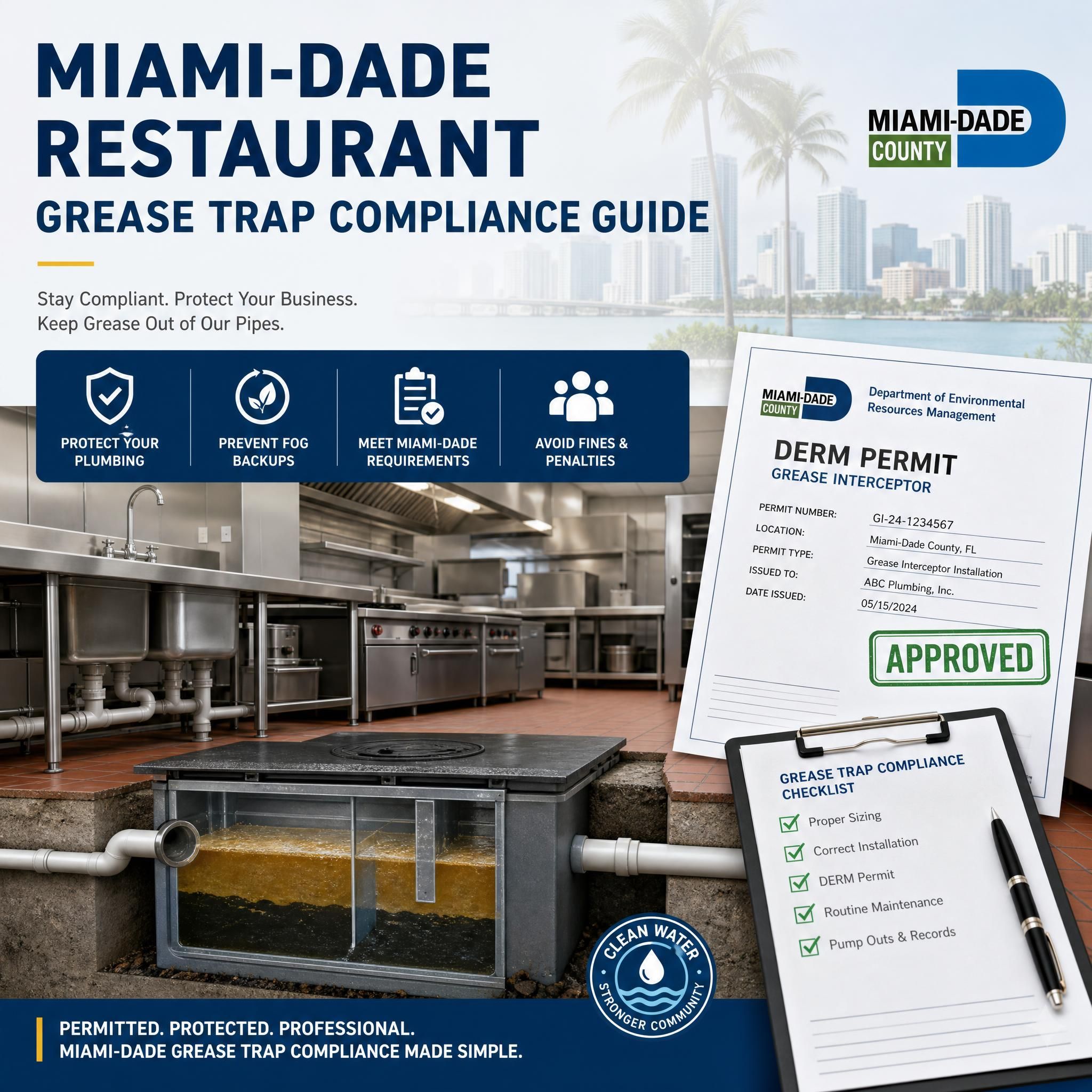
Last Updated: June 2026 | Applies to all food service establishments in Miami-Dade County, Florida
If you own or operate a restaurant, café, hotel kitchen, cafeteria, or any food service establishment in Miami-Dade County, grease trap compliance is not optional — it is a legal requirement enforced by one of the most active FOG (Fats, Oils, and Grease) programs in Florida. Failing to comply can result in permit revocation, steep daily fines, and even forced business closure.
Miami-Dade County and its municipalities are required under a federal court order to correct past and current issues relating to grease discharge in the county. One requirement under that court order is that Miami-Dade County implement a new FOG control program and local law — a framework now codified in Section 24-42.6 of the Miami-Dade County Code of Ordinances.
This comprehensive guide breaks down everything you need to know about Miami-Dade grease trap compliance in 2026: who must comply, how to get permitted, what maintenance is required, and how to avoid costly violations.
Table of contents
- What Is the Miami-Dade FOG Ordinance?
- Who Must Comply?
- Grease Trap vs. Grease Interceptor: Key Differences
- Step-by-Step Compliance Requirements
- The Role of DERM: Permits, Inspections & Reporting
- Common Violations and Penalties
- Best Practices for Ongoing Compliance
- Cost Breakdown: What to Budget For
- Compliance Checklist at a Glance
- Frequently Asked Questions
- Key Statistics
What is the miami-dade FOG ordinance?
The Miami-Dade FOG (Fats, Oils, and Grease) Control Program is a regulatory framework designed to prevent grease-laden wastewater from entering the county's sanitary sewer system. When FOG — defined as any vegetable or animal product used in or resulting from cooking or food preparation — flows untreated into sewer lines, it solidifies, causing blockages, sewer overflows, and serious environmental damage to South Florida's waterways.
The FOG Control Program, set forth in Section 24-42.6 of the Code, provides minimum requirements on FOG generators, including standards for the design and operation of FOG control devices. Among the program requirements is that a FOG generator obtain a FOG operating permit and submit an annual certification prepared by a professional engineer attesting that the existing FOG control devices are functioning as designed and are in good working order.
2026 regulatory updates
In February 2026, the Miami-Dade Board of County Commissioners introduced a resolution directing the County Mayor's office to study "whether the County's Fats, Oils, and Grease (FOG) regulations can be implemented or enforced in a manner that is less financially burdensome on local businesses." This signals that while the county is exploring ways to ease the financial impact on small businesses, enforcement of existing regulations remains fully active and strict.
A key 2026 concern stems from the rule that if a FOG control device is breached and such breach is the source of a prohibited wastewater, FOG, or food waste discharge, the responsible party shall within 90 days obtain from the County all required approvals and permits and install a new FOG control device that complies with the new and more demanding standards.
⚠️ Important: The FOG ordinance is not merely a guideline — it is a legally enforceable county code with real financial and operational consequences for non-compliant businesses.
Who must comply?
The scope of Miami-Dade's FOG program is broad. Any nonresidential facility that introduces food waste or other substances like vegetable or animal product used in, or a byproduct of cooking, food preparation, or cleaning processes, into the sanitary sewer system is required to have a GDO permit. This includes restaurants, bakeries, hotel and cafeteria kitchens, commercial kitchens, kitchens serving hospitals, nursing homes, daycares, assisted living facilities and other healthcare facilities, and food processing plants.
In practical terms, this covers:
- 🍽️ Full-service restaurants and fast-food establishments
- ☕ Cafés, coffee shops, and juice bars
- 🏨 Hotel and resort kitchens
- 🏥 Hospital, nursing home, and assisted living facility kitchens
- 🏫 School and daycare cafeterias
- 🛒 Supermarkets and food courts in shopping malls
- 🎉 Banquet halls and catering businesses
- 🏭 Food processing and manufacturing plants
FOG Discharge Control operating permits are renewed annually and are non-transferable. That means each time there is a sale, relocation, or legal transfer of an existing business the applicant must go through a FOG review of the existing system in place.
📊 One of Florida's most active FOG programs with automated nightly portal compliance checks – Miami-Dade FOG Enforcement
Grease trap vs. grease interceptor: key differences
One of the most common points of confusion for restaurant owners is understanding the difference between a grease trap and a grease interceptor. Miami-Dade regulations recognize both, but each serves different facility types and volumes.
| Feature | Hydromechanical Grease Interceptor (HGI) | Gravity Grease Interceptor (GGI) |
|---|---|---|
| How it works | Uses air entrapment, baffles & flow control | Uses large water volume to slow flow by gravity |
| Typical size | Smaller; installed indoors or under-sink | Larger; 300+ gallons, usually underground |
| Best for | Lower-volume food service establishments | High-volume restaurants, hotels, large kitchens |
| Cleaning frequency | More frequent (every 30–90 days) | Less frequent but full pump-outs required |
| Miami-Dade approval | Approved with WASD pre-approval | Required for high-volume operations |
| Efficiency requirement | Must meet 99% efficiency standard | Must meet 99% efficiency standard |
A hydromechanical grease interceptor increases separation performance through the use of flow control, air intake, and baffles, which markedly decreases the time necessary to separate FOG from wastewater. Gravity grease interceptors, by contrast, incorporate two or more compartments in series, a minimum volume of 300 gallons, and use their larger volume of water to slow the flow velocity, allowing FOG to rise by buoyancy.
Sizing requirements
Miami-Dade uses a flow rate method for HGIs and a volume-based calculation for gravity interceptors. WASD provides a sizing worksheet through its industrial waste program. DERM's two-step sizing method considers both flow rate and grease production to determine the correct system. Selecting an undersized unit is one of the most common and costly compliance mistakes.
📊 99% minimum FOG removal efficiency required for all new Miami-Dade installations – Grease Trap Efficiency Requirement
Step-by-step compliance requirements
Step 1: obtain a municipal certificate of use
If your facility is located within a municipality like the City of Miami, Coral Gables, or Miami Beach, the first step is to apply for a municipal occupational license/certificate of use from the city before submitting a GDO permit application to DERM. Note: all municipalities require that DERM approve the municipal certificate of use application, so you will be routed to DERM for approval.
Step 2: apply for your FOG GDO permit through DERM
Access DERM's online portal and submit a completed FOG Operating Permit application, uploading required documents including business name, facility square footage, and grease trap specifications. Documentation requirements include a FOG Generator Disclosure Statement (required for property owners) and notarized signatures from authorized representatives.
Step 3: install an approved, properly sized grease control device
Your grease interceptor or hydromechanical grease trap must:
- Meet DERM's 99% FOG removal efficiency standard
- Be sized correctly using DERM's two-step flow rate and grease production method
- Include a solids interceptor, grease interceptor, and sampling port as outlined in the FOG 2.5 Control Device Guidance Manual
- Be installed by a licensed contractor
Step 4: maintain your system and report cleanings
Miami-Dade County Code requires all non-residential food service facilities to have the system cleaned by a licensed hauler at the frequency specified in the GDO, and to report each cleaning via the county's online portal. Starting January 2017, all cleanings must be reported electronically.
Step 5: renew annually
Permit approval typically takes 30 days. Permits remain valid for one year (January 1st – December 31st), and renewal notices are sent 45 days before expiration.
Mandatory record-keeping
Maintenance logs must be kept on-site and accessible for DERM inspections. Records must include dates of cleaning and pump-outs, service provider details, and repair and maintenance history. Retain records for a minimum of 3 years.
The role of DERM: permits, inspections & reporting
The Miami-Dade Department of Environmental Resources Management (DERM), operating through the Water and Sewer Department's (WASD) Industrial Waste Section, is the primary enforcement authority for the FOG program.
The Miami-Dade County Department of Environmental Resources Management "DERM" is the department that regulates, among other things, grease traps. It does so through its fats, oils, and grease "FOG" program.
What DERM oversees:
- Permit issuance and renewal for all GDO permits
- Plan review for new grease trap installations
- Inspection of food service establishments for compliance
- Enforcement actions for violations
- Online portal management for electronic cleaning reports
WASD conducts FSE inspections; Miami-Dade has one of the most active FOG enforcement programs in Florida.
The annual PE certification
A critical but often overlooked requirement: FOG generators must submit an annual certification prepared by a professional engineer attesting that the existing FOG control devices are functioning as designed and are in good working order. Failing to submit this certification on time is a common compliance gap that triggers enforcement actions.
Common violations and penalties
Miami-Dade enforces its FOG program aggressively — and increasingly, it does so using technology. Miami-Dade enforces FOG rules with software, not clipboards. Every night at 2 a.m. the county's portal cross-checks pump-out manifests against each kitchen's permit. When a log shows 91 days without a service ticket or a grease trap that topped 25 percent last inspection, the script auto-issues a $250 administrative fee and queues a violation letter before an inspector even starts the truck.
Most common violations
| Violation Type | Description | Typical Consequence |
|---|---|---|
| Late or missing cleaning report | Failure to electronically report pump-out on time | $250 administrative fee, auto-issued |
| Exceeding 25% capacity rule | Grease layer + solids exceed 25% of trap volume | Immediate citation, mandatory service |
| Unpermitted operation | Operating without a valid GDO permit | Permit denial, enforcement action |
| Non-compliant equipment | Grease trap below 99% efficiency standard | Mandatory upgrade within 90 days |
| Illegal grease dumping | Disposing of grease improperly | Fines starting at $570, doubling on repeat |
| Missing maintenance records | No on-site logs available during inspection | Citation, potential permit revocation |
| Using unlicensed hauler | Pump-out performed by non-DERM-approved hauler | Violation, records invalidated |
Fine structure
A second offence for dumping jumps to $1,150 under the new schedule passed in May 2025. Violations can result in escalating penalties, from initial warnings to significant fines ranging from $100 to $10,000 per day of non-compliance in severe cases.
Lose a service manifest and you face a $250 citation; fail to present it and enforcement can fine up to $100 per missing form.
⚠️ Business Closure Risk: Repeated or severe violations can result in permit revocation, which effectively shuts down food service operations. The WPLG Local 10 "Dirty 30" report from April 2026 highlighted Miami-area restaurants accumulating 30 or more health and compliance violations — a reminder that enforcement is real and public.
Best practices for ongoing compliance
1. choose a DERM-licensed grease hauler
Grease waste haulers in Miami-Dade must be licensed with WASD and hold a valid Class I or Class II hauler permit. Always verify your hauler's Miami-Dade permit number. Never assume a vendor is licensed — request their permit documentation before scheduling service.
2. follow the 25% rule proactively
Don't wait for an inspection to discover your trap is over capacity. Establish a service schedule that keeps your grease trap well below the 25% threshold. For high-volume kitchens, this may mean monthly or even more frequent service.
3. train your kitchen staff on FOG management
Employee behavior is your first line of defense. Implement these kitchen practices:
- Dry wipe pots, pans, and plates before washing to remove excess grease
- Never pour cooking oil or grease directly down drains
- Use drain screens and clean them regularly
- Post FOG awareness reminders in back-of-house areas
- Train all new hires on proper grease disposal during onboarding
4. use digital compliance tracking
Manual logbooks are prone to errors and gaps. Consider using digital tools or apps to:
- Schedule and track pump-out appointments
- Receive alerts when service is due
- Store digital copies of manifests and service records
- Set reminders for annual permit renewals and PE certifications
5. conduct internal inspections
Designate a staff member as a compliance officer who performs monthly internal checks: inspect the trap visually, verify records are current and on-site, and confirm the next scheduled service date.
Cost breakdown: what to budget for
Understanding the true cost of grease trap compliance helps you plan appropriately and avoid budget surprises.
Installation costs
Grease trap installation for restaurants in Miami-Dade typically costs $2,000–$15,000 depending on trap size, material type, installation location, site conditions, and complexity. Small traps (35–50 gallons) cost $1,500–$3,000. Medium traps (100–500 gallons) cost $3,000–$8,000. Large traps (750–1,500 gallons) cost $8,000–$15,000.
Permit and inspection fees
Permit fees cost $300–$1,500. Health department review costs $200–$800. Inspection fees cost $150–$500. Total permit costs typically run $650–$2,800.
Ongoing maintenance costs
| Service | Estimated Cost | Frequency |
|---|---|---|
| Grease trap pump-out (small HGI) | $150–$350 | Monthly to quarterly |
| Grease interceptor pump-out (large GGI) | $400–$1,200 | Quarterly to semi-annually |
| Annual PE certification | $500–$1,500 | Annually |
| GDO permit renewal | $200–$500 | Annually |
| Digital compliance monitoring system | $1,200–$2,500 installed | One-time + subscription |
📊 $2,000–$15,000 for most Miami-Dade restaurant installations – Grease Trap Installation Cost Range
Budget planning tips
- Factor compliance into your startup costs if opening a new restaurant — don't treat it as an afterthought
- Bundle services where possible: some providers offer combined installation, maintenance, and compliance consulting packages
- Invest in monitoring technology upfront — automated grease level sensors ($1,200–$2,500) typically pay for themselves within 18–24 months through avoided emergency service calls and reduced pumping frequency
Compliance checklist at a glance
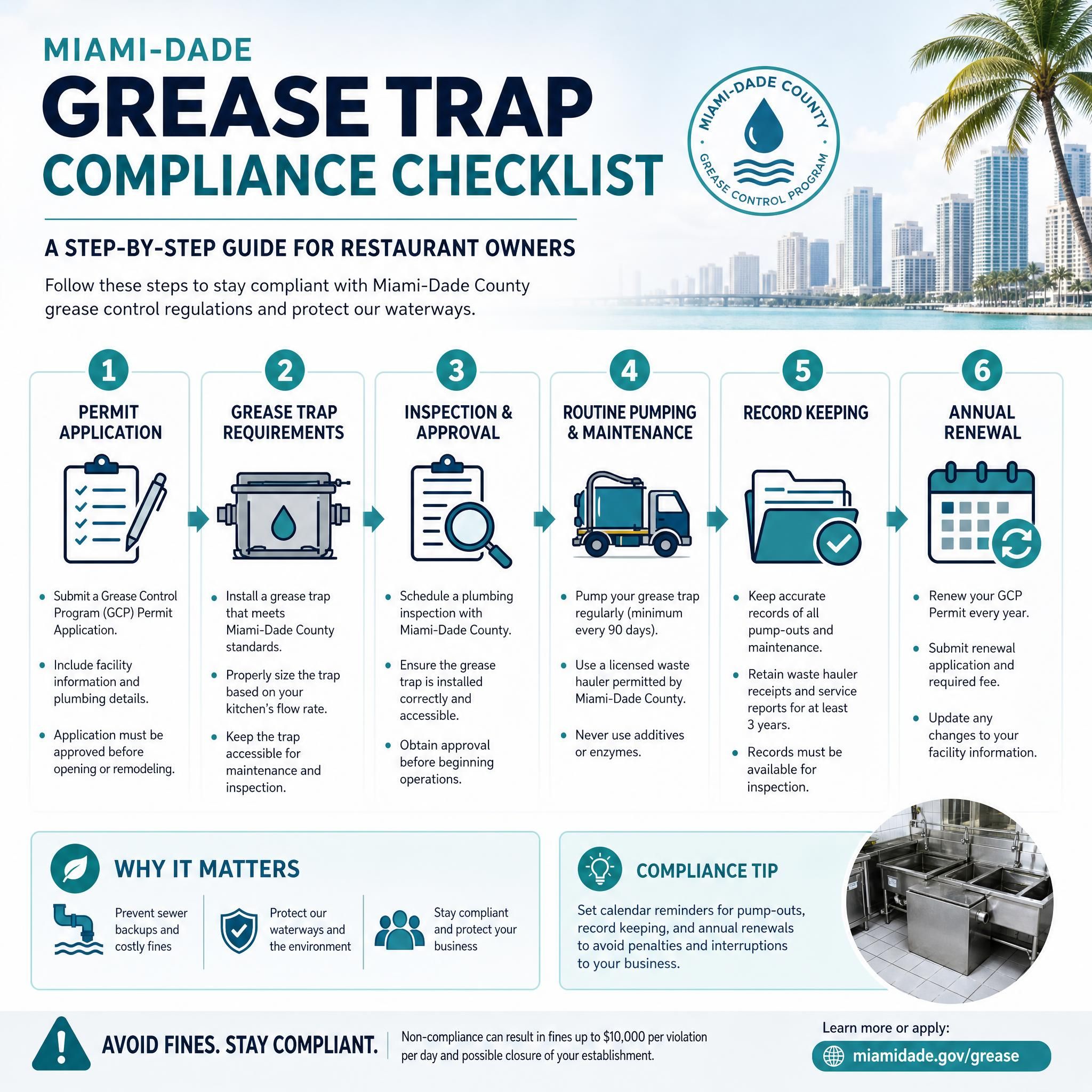
Use this checklist to assess your current compliance status:
Before Opening:
- Determine if your establishment qualifies as a FOG generator
- Apply for a municipal Certificate of Use
- Submit FOG GDO permit application via DERM's online portal
- Have a licensed engineer design and size your grease interceptor
- Install a DERM-approved, 99%-efficient grease control device
- Obtain final installation inspection and permit approval
Ongoing Operations:
- Clean grease trap at DERM-specified frequency (every 30–90 days, or at 25% capacity)
- Use only DERM-licensed haulers for all pump-outs
- Electronically report each cleaning via the county portal within the required timeframe
- Maintain on-site maintenance logs for a minimum of 3 years
- Submit annual PE certification confirming system functionality
- Renew GDO permit annually before December 31st
When Buying or Leasing a Property:
- Request FOG Generator Disclosure Statement from seller/lessor
- Inspect existing grease trap for compliance with current DERM standards
- Verify the system meets the 99% efficiency requirement
- Apply for a new GDO permit (permits are non-transferable)
Frequently asked questions
How often must grease traps be cleaned in miami-dade?
The frequency of cleaning depends on the size of the grease trap and the volume of FOG generated. Typically, businesses are advised to clean grease traps every 30 to 90 days, or when the trap is 25% full. Your specific cleaning frequency will be stated in your GDO permit. High-volume restaurants may need monthly service, while lower-volume establishments may qualify for quarterly cleaning. Always follow the schedule in your permit — not just industry averages.
What happens during a DERM inspection?
During a DERM inspection, an inspector will verify that your grease trap is properly installed and functioning, review your on-site maintenance logs and service manifests, check that all pump-outs have been electronically reported, confirm that your GDO permit is current and posted, and assess whether your system meets the 99% efficiency standard. WASD conducts FSE inspections and Miami-Dade has one of the most active FOG enforcement programs in Florida, so inspections are thorough and unannounced visits do occur.
Can i handle grease trap maintenance in-house?
No. Miami-Dade County requires that the system be cleaned by a licensed hauler at the frequency specified in the GDO. Using an unlicensed hauler or attempting to self-service the system will invalidate your compliance records. All pump-outs must be performed by a hauler holding a valid WASD Class I or Class II hauler permit, and each service must be reported electronically through the county portal.
What if i'm opening a new restaurant in miami-dade?
If you're opening a new restaurant, grease trap compliance must be addressed before you can obtain your Certificate of Use and begin operations. Start the process early — permit approval typically takes 30 days, and installation, inspection, and engineering work add additional time. Budget for installation ($2,000–$15,000+), permit fees ($650–$2,800), and ongoing maintenance from day one. Contact DERM's online portal to begin the application process and consult with a licensed FOG compliance professional to ensure your system is correctly sized and installed.
Does buying an existing restaurant mean i inherit the grease trap permit?
No. FOG Discharge Control operating permits are non-transferable. That means each time there is a sale, relocation, or legal transfer of an existing business, the applicant must go through a FOG review of the existing system in place. Additionally, under Ordinance No. 23-23, sellers are legally required to provide a FOG Generator Disclosure Statement to buyers before completing the transaction.
Key statistics
📊 $250 — Automatic administrative fee issued by Miami-Dade's portal when a pump-out manifest is missing or overdue, triggered nightly by automated software (Source: GreaseConnections Miami-Dade FOG Rules, 2026)
💡 $1,150 — Fine for a second grease dumping offence in Miami-Dade under the updated May 2025 violation schedule (Source: GreaseConnections, 2026)
🔧 99% — Minimum FOG removal efficiency required for all grease interceptors installed in Miami-Dade County under current DERM standards (Source: Miami-Dade DERM FOG 2.5 Control Device Guidance Manual)
⏱️ 3 Years — Minimum period for which all maintenance logs, service manifests, and pump-out records must be retained on-site and available for inspection (Source: Miami-Dade DERM FOG Program)
Conclusion
Miami-Dade grease trap compliance is not a bureaucratic formality — it is a legally mandated, actively enforced program that directly impacts your ability to operate a food service business in the county. With automated nightly compliance checks, a strict 99% efficiency requirement, non-transferable permits, and fines that escalate rapidly on repeat offences, the stakes for non-compliance are high.
Whether you are planning to open your first restaurant in Miami, managing an existing operation, or purchasing a commercial property with a food service tenant, understanding and adhering to the Miami-Dade FOG ordinance is essential.
Your next steps:
- ✅ Download the compliance checklist above and audit your current status
- 📞 Schedule a FOG compliance assessment with a licensed Miami-Dade grease trap professional
- 🖥️ Visit DERM's online portal to verify your GDO permit status or begin a new application
- 📅 Set calendar reminders for your next scheduled pump-out, electronic report submission, and annual permit renewal
- 📋 Sign up for compliance reminder notifications to stay ahead of deadlines
Don't wait for a $250 auto-citation or an unannounced DERM inspection to discover a compliance gap. Proactive grease trap management protects your business, your community's sewer infrastructure, and South Florida's environment.
For questions about Miami-Dade FOG compliance, contact DERM's WASD Industrial Waste Section at (305) 547-2840 or visit the Miami-Dade County official website.