
If you own or operate a food service establishment in Miami-Dade County, grease trap compliance isn't optional — it's the law. Violating Miami-Dade's Fats, Oils, and Grease (FOG) regulations can result in fines of up to $10,000 per violation, permit revocation, and even forced business closure. And with enforcement growing stricter in 2026, there has never been a more critical time to understand exactly what the county requires.
This guide breaks down everything restaurant owners, operators, property managers, and food service entrepreneurs need to know about Miami-Dade grease trap compliance — from permit applications and installation standards to maintenance schedules, inspection procedures, and cost planning.
Table of contents
- What Is the Miami-Dade FOG Program?
- Who Must Comply?
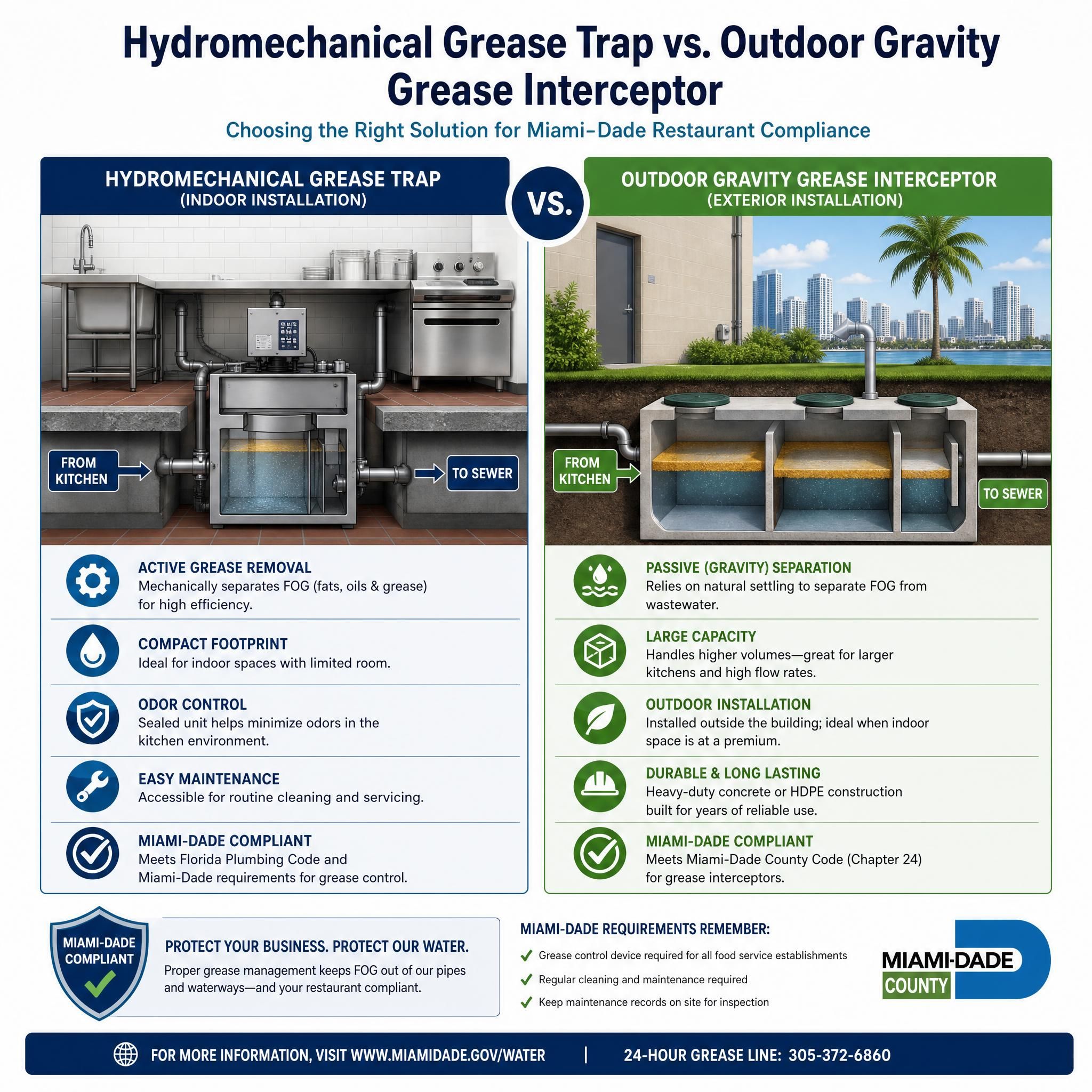
- Grease Trap vs. Grease Interceptor: Key Differences
- Step-by-Step Compliance Requirements
- The Role of Miami-Dade DERM
- Common Violations and Penalties
- Best Practices for Ongoing Compliance
- Cost Breakdown for Miami-Dade Restaurants
- Frequently Asked Questions (FAQ)
- Key Statistics
What is the miami-dade FOG program?
The FOG (Fats, Oils, and Grease) Control Program is Miami-Dade County's regulatory framework designed to prevent grease discharge from commercial kitchens from damaging the county's public sanitary sewer system. When FOG enters the sewer system, it solidifies, blocks pipes, causes sewer overflows, and can create serious environmental hazards — including contamination of Biscayne Bay.
Miami-Dade restaurants operate under three overlapping regulatory frameworks: Miami-Dade Ordinance No. 18-22 at the county level, Florida Statute § 403.0741 at the state level, and the federal Industrial Pretreatment Program under the Clean Water Act at the federal level. Each layer imposes independent obligations, and stricter local rules always take precedence over state minimums.
Miami-Dade Ordinance No. 18-22 is the primary local authority, codified at Section 24-42.6 of the County Code. The ordinance establishes the GDO permit requirement, interceptor sizing and installation standards, the 25% Rule for maintenance, DERM-permitted hauler requirements, and the electronic reporting mandate through the county FOG portal.
Ordinance No. 18-22 was enacted pursuant to a federal consent decree among Miami-Dade County, the U.S. Environmental Protection Agency, and the Florida Department of Environmental Protection, approved by the EPA and FDEP in September 2017. The FOG ordinance itself became effective on March 5, 2018, and has been actively enforced — and periodically updated — ever since.
In May 2026, the Town of Cutler Bay, in partnership with Miami-Dade County's Building Department, hosted a dedicated FOG Roundtable Workshop for local food service businesses — a clear signal that county-wide enforcement awareness is intensifying. The workshop was available in a hybrid format, held on May 13, from 10:00 AM to 12:00 PM, underscoring the county's commitment to educating business owners about FOG compliance obligations.
2026 regulatory updates to know
- Annual GDO permits now expire on December 31 each year and must be renewed before that date
- Pursuant to Ordinance No. 23-23, the County revised its Grease Trap Operating Permit Application Form to reference the new FOG generator disclosure statement required before the sale or lease of certain real property
- Electronic reporting of all cleaning events through the county's FOG portal is mandatory
- A professional engineer's annual certification attesting that FOG control devices are functioning as designed is now required
Who must comply?
Every non-residential food service establishment in Miami-Dade County is required to comply — no exceptions.
According to DERM guidelines, any non-residential facility that handles, prepares, or processes food must install a grease trap and obtain a FOG Discharge Control Operating Permit. Businesses requiring this include restaurants, cafés, cafeterias, supermarkets, food courts, hotels and banquet facilities, healthcare facility kitchens (e.g., hospitals, nursing homes), schools, and daycare centers with food preparation.
This means the compliance obligation extends far beyond traditional sit-down restaurants. If your establishment generates any fats, oils, or grease as part of food preparation or cleaning — and discharges wastewater to the public sewer — you are a FOG generator under Miami-Dade County Code and must have a valid GDO permit.
Grease trap vs. grease interceptor: key differences
Understanding the distinction between these two devices is essential for compliance, as Miami-Dade DERM requires specific equipment based on your facility type, size, and kitchen volume.
| Feature | Hydromechanical Grease Trap (HGT) | Gravity Grease Interceptor (GGI) |
|---|---|---|
| Location | Indoors, under the sink | Outdoors, underground |
| Size | Smaller (measured in GPM) | Large (750–2,000+ gallons) |
| Cleaning Frequency | Monthly (Miami-Dade requirement) | Every 60 days (or 180 days with monitoring device) |
| Typical Use | Lower-volume establishments | High-volume restaurants and food courts |
| Installation Cost | $1,500–$5,000 | $8,000–$25,000+ |
| Efficiency Requirement | 99% FOG removal | 99% FOG removal |
Florida uses a dual system: hydromechanical grease traps (HGTs) inside the building and gravity grease interceptors (GGIs) outside, with FAC 64E-6 setting a minimum 750-gallon volume for any gravity unit and capping a single chamber at 1,250 gallons.
Miami-Dade DERM requires all installed grease traps to be 99% efficient in FOG removal — a specification that significantly narrows the range of approved manufacturers and models. When sizing your system, a licensed engineer will calculate the appropriate capacity based on your kitchen's wastewater flow rate, the number of fixtures draining into the system, and your menu's grease-generating potential.
Step-by-step compliance requirements
Step 1: obtain a municipal certificate of use
If your facility is located within a municipality like the City of Miami, Coral Gables, or Miami Beach, the first step is to apply for a municipal occupational license/certificate of use from the city before submitting a GDO permit application to DERM. Note: all municipalities require that DERM approve the municipal certificate of use application.
Step 2: install an approved grease control device
Your grease trap or interceptor must:
- Be sized appropriately for your kitchen's flow rate
- Meet Miami-Dade's 99% efficiency standard
- Be installed by a licensed plumbing contractor
- Include a sample port for inspection purposes
- Be positioned per DERM's installation guidelines
Step 3: apply for a GDO permit from DERM
Every non-residential food service establishment in Miami-Dade County must obtain a Grease Discharge Operating (GDO) Permit from DERM before opening. The permit is non-transferable, expires on December 31 each year, and must be renewed before that date to avoid automatic compliance violations.
The GDO Permit contains critical compliance information you must know: the permit validity dates, system type (whether it's a grease interceptor, trap, or another device — each has unique maintenance needs), the number of systems, system capacity (usually measured in gallons per minute), cleaning frequency (the GDO specifies intervals such as every 30 days), and reporting deadline (many permits require monthly or quarterly submission by the 20th, and late reports may trigger penalties).
Step 4: maintain required cleaning schedules
Miami-Dade hydromechanical units require monthly cleaning, while gravity interceptors are cleaned every 60 days (or 180 days with a monitoring device).
The 25% Rule is the universal standard: if the combined FOG and solids layer reaches 25% of your trap's total capacity, cleaning is mandatory — regardless of how recently the last service was performed. High-volume kitchens serving fried foods typically require monthly service even for gravity interceptors.
All cleaning must be performed by a DERM-licensed hauler. Skimming, decanting, or returning any wastewater to the system is strictly prohibited. Unlicensed haulers are not permitted under any circumstances.
Step 5: report and keep records
Starting January 2017, all cleanings must be reported electronically. Improper maintenance or failure to report can result in citations or other enforcement actions.
You must maintain:
- Grease trap maintenance logs (on-site)
- Service manifests from every licensed hauler visit
- Annual professional engineer certification
- Cleaning records for a minimum of 3 years
Florida Statute § 403.0741(3)(e) separately requires that service manifests be retained on-site by the originator and the hauler for 1 year, with a copy delivered to the originator and the relevant county and municipality within 30 days of disposal.
The role of miami-dade DERM
The Miami-Dade County Department of Environmental Resources Management (DERM) is the department that regulates grease traps. It does so through its Fats, Oils, and Grease (FOG) program.
DERM handles:
- GDO permit issuance and renewal — processed through DERM's online portal
- Inspection protocols — routine and complaint-triggered inspections of grease control devices
- Progressive enforcement — from administrative warnings to civil penalties and permit revocation
- Hauler licensing — only DERM-licensed haulers may pump and transport grease waste in Miami-Dade County
- Electronic manifest review — DERM verifies all submitted cleaning reports through its FOG portal
Routine inspections focus on maintenance log currency, manifest completeness, and storage area condition — inspectors use core sampling tools to verify the 25% threshold in real time. Missing records trigger a $250 charge and a return visit within 72 hours under DERM's progressive enforcement protocol.
Operators should check interceptors for damage, overflow, or loose components within 24 hours after any storm, per Miami-Dade DERM guidance. Post-storm FOG releases that reach stormwater drains or Biscayne Bay trigger the highest enforcement tier.
DERM also publishes an approval matrix on its website to help operators determine which permit pathway applies to their specific situation — whether they are a new establishment, an existing business upgrading equipment, or a property changing tenants.
Common violations and penalties
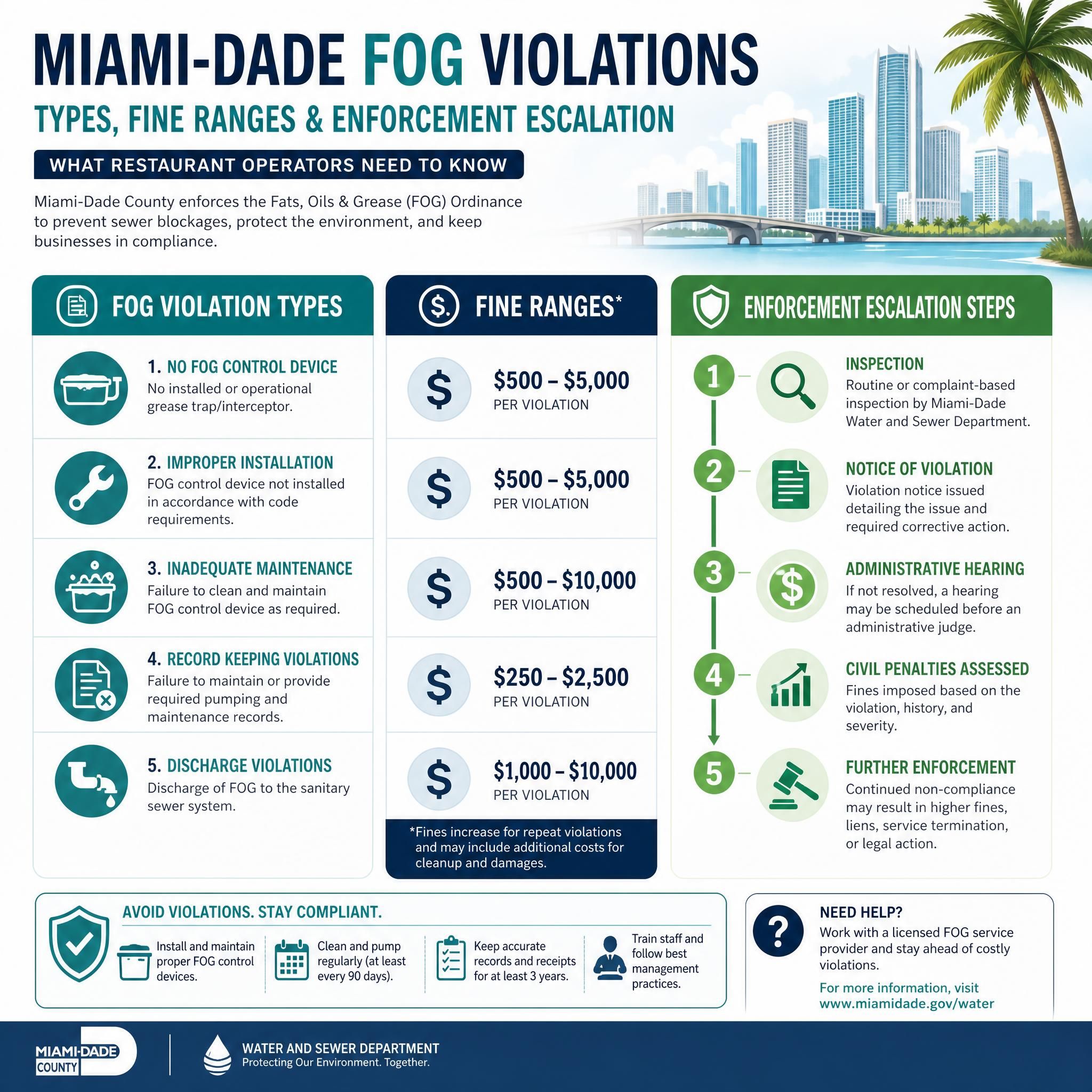
Non-compliance with Miami-Dade's FOG ordinance carries serious financial and operational consequences. Miami-Dade FOG violations carry fines under two parallel frameworks: Miami-Dade County Code Chapter 8CC civil penalties enforced by DERM, and Florida Statute § 403.0741 administrative fines enforced by the Florida DEP and authorized inspecting entities. Both frameworks apply simultaneously — a single violation can generate fines under both.
Most common violations
| Violation Type | Consequence |
|---|---|
| Operating without a valid GDO permit | Permit denial, fines, business closure |
| Failure to clean at required frequency | $250+ administrative charge + return inspection |
| Late upload of grease discharge reports | $250 administrative charge per incident |
| Using an unlicensed hauler | Fines + permit suspension |
| Missing or incomplete service manifests | $250 citation per missing form |
| FOG exceeding 25% of trap capacity | Immediate citation + mandatory re-inspection |
| Environmental release to stormwater/Biscayne Bay | Maximum enforcement tier + federal referral |
Violations can result in escalating penalties, from initial warnings to significant fines ranging from $100 to $10,000 per day of non-compliance in severe cases.
Permit revocation under Section 24-42.6 operates in addition to — not instead of — any financial penalties assessed. DERM's Environmental Code Enforcement Section uses progressive enforcement based on violation severity, environmental threat, and evidence obtained during inspection.
Environmental violations that reach Biscayne Bay or stormwater infrastructure carry the highest enforcement tier and can escalate to federal referral under the Clean Water Act consent decree.
The bottom line: A single serious violation can cost your restaurant tens of thousands of dollars in fines, remediation costs, and lost business — far exceeding the cost of proper maintenance.
Best practices for ongoing compliance
Choose a licensed grease trap service provider
Only DERM-licensed haulers are permitted to service Miami-Dade grease traps. When evaluating providers, verify:
- Current DERM hauler license and decal
- Electronic manifest submission capability
- Experience with Miami-Dade's specific reporting requirements
- Ability to provide documentation for your compliance records
Train your staff on FOG management
Employee behavior in the kitchen is one of the most powerful tools in your compliance toolkit. Implement the following kitchen practices:
- Dry-wipe all pans, pots, and cookware before washing to remove grease before it enters the drain
- Install and regularly empty grease collection containers near cooking stations
- Post FOG awareness signage in dishwashing and prep areas
- Never pour cooking oil, fryer grease, or food scraps directly down any drain
- Conduct monthly staff training on proper FOG disposal procedures
Use digital compliance tracking tools
Manual logbooks are error-prone and difficult to audit. Consider using:
- Digital maintenance logs synced to the DERM reporting portal
- Automated service reminders tied to your GDO cleaning schedule
- Cloud-stored manifest archives accessible during surprise inspections
- Compliance calendar apps that alert you to permit renewal deadlines (December 31 each year)
Schedule proactive inspections
Don't wait for DERM to come to you. Schedule quarterly self-audits using DERM's FOG Condition Assessment form to identify issues before they become violations. After every major storm event, inspect your interceptor within 24 hours per DERM guidance.
Cost breakdown for miami-dade restaurants
Understanding the full cost of compliance helps you budget effectively and avoid the far greater expense of violations.
| Cost Category | Estimated Range | Notes |
|---|---|---|
| Hydromechanical Grease Trap (HGT) Installation | $1,500–$5,000 | Under-sink, indoor units |
| Gravity Grease Interceptor (GGI) Installation | $8,000–$25,000+ | Outdoor, underground systems |
| Permit Fees (GDO) | $300–$1,500 | Annual renewal required |
| Health Dept. Review | $200–$800 | Part of initial permitting |
| Inspection Fees | $150–$500 | Per inspection event |
| Monthly HGT Pumping | $115–$475 | Per service visit |
| GGI Pumping (every 60 days) | $325–$1,040 | Per service visit |
| Annual PE Certification | $500–$2,000 | Engineer attestation required |
| FOG Violation Fine | $250–$10,000+ per day | Avoidable with compliance |
Grease trap installation requires permits and compliance, and permit fees cost $300–$1,500, health department review costs $200–$800, and inspection fees cost $150–$500, with total permit costs typically ranging from $650–$2,800.
Budget Planning Tips:
- Factor grease trap maintenance into your monthly operating budget from day one
- Annual GDO renewal should be calendared in October to avoid December 31 lapses
- Build a contingency fund for unexpected repairs — DERM does not grant grace periods for equipment failures
- Over a 5–10 year period, total ownership costs (maintenance + permits + service) typically run 2 to 5 times the initial installation cost
Frequently asked questions (FAQ)
How often must grease traps be cleaned in miami-dade?
Miami-Dade hydromechanical units require monthly cleaning, while gravity interceptors are cleaned every 60 days (or 180 days with a monitoring device). However, the 25% Rule overrides any schedule: if FOG and solids reach 25% of your trap's capacity before the scheduled service date, cleaning is immediately required. High-volume establishments may need service more frequently than their GDO schedule specifies.
What happens during a miami-dade DERM grease trap inspection?
Routine inspections focus on maintenance log currency, manifest completeness, and storage area condition — inspectors use core sampling tools to verify the 25% threshold in real time. Missing records trigger a $250 charge and a return visit within 72 hours under DERM's progressive enforcement protocol. Inspectors may arrive unannounced, so your documentation should always be current and accessible on-site.
Can i handle grease trap maintenance in-house?
In Miami-Dade County, no. All pumping and cleaning of grease traps must be performed by a DERM-licensed hauler. Internal staff may perform visual checks and dry-wiping practices to reduce grease load, but the actual cleaning, pumping, and waste hauling must be done by a licensed contractor who can submit the required electronic manifests to DERM.
What if i'm opening a new restaurant in miami-dade?
If you are opening a new food service establishment, you must complete the following before opening:
- Apply for a Municipal Certificate of Use from your city (Miami, Miami Beach, Coral Gables, etc.)
- Have an approved grease trap or interceptor designed, permitted, and installed
- Obtain a GDO Permit from DERM before beginning operations
- Ensure your hauler is DERM-licensed and your electronic reporting is set up
The process for getting a FOG GDO permit depends on factors like whether the facility previously had a GDO permit, whether an approved grease trap has already been installed, and whether the grease trap meets current requirements. DERM's approval matrix on their website guides new applicants through the correct pathway.
What is the FOG generator disclosure requirement for property sales?
The FOG Control Program, set forth in Section 24-42.6 of the Code, provides minimum requirements on FOG generators, including standards for the design and operation of FOG control devices. Among the Program requirements is that a FOG generator obtain a FOG operating permit and submit an annual certification prepared by a professional engineer attesting that the existing FOG control devices are functioning as designed and are in good working order. Property owners selling or leasing premises with grease traps must now disclose this to buyers/tenants under Ordinance No. 23-23.
Key statistics
📊 $10,000 per violation per day – Miami-Dade FOG Violation Fine Maximum
📊 99% FOG removal – Grease Trap Efficiency Requirement
📊 750 gallons – Minimum Gravity Interceptor Size in Florida
📊 December 31 every year – Annual GDO Permit Expiration
📊 $10,000/day — Maximum fine per FOG violation under Miami-Dade County Code Chapter 8CC
💡 99% — Required FOG removal efficiency for all grease traps installed in Miami-Dade County
⚠️ $250 — Automatic administrative charge for missing or late grease discharge report uploads to the DERM portal
🗓️ December 31 — Annual GDO permit expiration date; renewal must be completed before this date every year
Conclusion: take action before DERM comes to you
Miami-Dade's FOG ordinance is one of the most rigorously enforced environmental compliance programs in South Florida — and for good reason. Grease discharge damages sewer infrastructure, threatens Biscayne Bay, and creates public health hazards. The county has made clear, through active inspections, escalating fines, and outreach programs like the 2026 Cutler Bay FOG Workshop, that it expects full compliance from every food service establishment operating within its jurisdiction.
Whether you are planning to open a new restaurant, operating an established kitchen, or managing a commercial property with food service tenants, the time to act is now:
- ✅ Planning stage: Engage a licensed plumbing contractor and DERM-approved engineer to design your grease control system before you sign a lease
- ✅ Opening stage: Obtain your municipal Certificate of Use and GDO permit before your first day of service
- ✅ Operating stage: Audit your cleaning logs, verify your hauler's DERM license, and confirm your electronic reporting is current
Ready to get compliant? Download a free Miami-Dade FOG compliance checklist, schedule a consultation with a DERM-licensed grease trap service provider, or sign up for permit renewal reminders to ensure your restaurant never faces a surprise inspection unprepared.
Non-compliance is not just a regulatory risk — it is an existential threat to your business. A single serious FOG violation can trigger permit revocation, forced closure, and fines that take years to recover from. Investing in proper grease trap installation, maintenance, and documentation is the most cost-effective decision any Miami-Dade restaurant operator can make in 2026.
""Any non-residential facility that handles, prepares or processes food discharges or has the potential to discharge FOG to the public sanitary sewer system requires a FOG Discharge Control operating permit.""
— Miami-Dade County DERM
""Miami-Dade Ordinance No. 18-22 is the primary local authority, codified at Section 24-42.6 of the County Code.""
— GreasePros Recycling – Miami-Dade FOG and GDO Compliance Guide